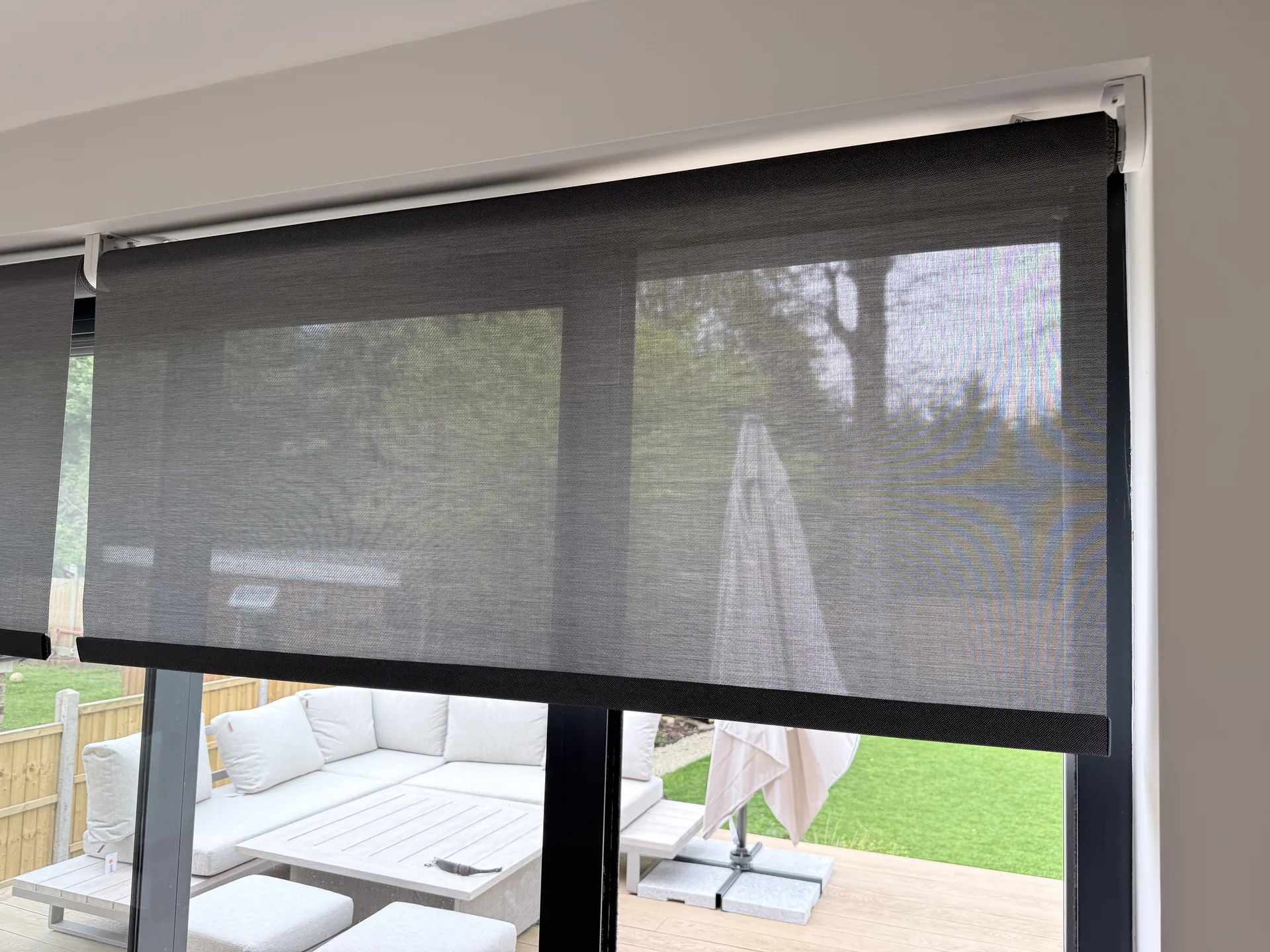
Why motorised shading is worth considering at all
The case for motorised shading is more practical than it might initially seem. Large windows — particularly floor-to-ceiling glazing, roof lights, and south-facing façades — are a feature of virtually every high-quality new build or extension in Berkshire, Surrey, and Oxfordshire. They bring light and a sense of space. They also bring solar heat gain in summer that makes a room uncomfortable by mid-morning, UV damage to furniture and flooring, and glare on screens that makes a television unwatchable.
Manual blinds are a partial solution, but they require someone to physically adjust them — and in practice, they often don't get adjusted at all. The rooms that need shading most (large glazed spaces, roof lights, full-height windows) tend to be the ones where manual operation is most awkward and least likely to happen.
Motorised shading solves the operation problem. Once the system is set up correctly, shading adjusts itself: closing south-facing blinds when the sun reaches a certain angle, opening again when clouds come over, dropping bedrooms to blackout at a set time each evening. It becomes background infrastructure rather than something the household has to manage.
The main fabric types — and what they actually do
The fabric is where most of the specification work happens, because the fabric determines what the blind is for. The key categories are:
- Solar or screen fabrics. These are the workhorses of a shading scheme. A solar fabric reduces glare and heat gain while maintaining a view through the window. Openness factor matters here — a 1% openness fabric is almost opaque, giving excellent solar control but a more enclosed feel. A 5% fabric lets more light through and preserves more of the view. For rooms with television or significant glazed areas, a 3–5% solar fabric in a neutral tone tends to work well. These fabrics are not blackout — they reduce rather than eliminate light.
- Blackout fabrics. True blackout fabrics eliminate virtually all light. They're essential in bedrooms and in dedicated home cinema rooms. The quality of blackout varies between fabrics and manufacturers — cheaper blackouts pass light around the edges of the blind. For a proper cinema environment, side channels or a cassette recess that holds the fabric against the reveal are necessary to achieve the darkness the room needs.
- Translucent and sheer fabrics. A sheer or translucent fabric softens the light coming into a room without significantly reducing it. Useful in living spaces where privacy is the goal rather than solar control, or as a lower blind in a dual-blind system where a sheer and a blackout are combined on the same window.
- Dual or day-night systems. Many projects use two blinds per window — a solar or sheer fabric for daytime use and a blackout for the evening or night. Both fabrics typically sit within a single cassette housing and are operated independently. This combination gives the most flexibility across different times of day and different purposes.
Motorisation systems: Lutron, Rako, and KNX
The motor and control system determine how well the shading integrates with the rest of the home and how reliably it operates over time. We work with three primary systems depending on the project.
Lutron is the gold standard for motorised shading. Lutron makes their own motors, their own fabrics, and their own control hardware — the whole system is designed together, which means it behaves as a coherent product rather than an assembly of parts from different manufacturers. Lutron's Sivoia QS Wireless and QS Triathlon systems are extremely reliable, virtually silent, and integrate natively with every major smart home platform including Savant, Crestron, and KNX. The Lutron ecosystem also includes excellent lighting control, which means shading and lighting scenes can be coordinated from a single system. The trade-off is cost: Lutron shading is premium-priced, and this is reflected in the quotation.
Rako offers a capable, well-supported shading system that works in both wired and wireless configurations and integrates well with their lighting control products. For projects where the budget doesn't stretch to Lutron or where Rako lighting is already specified, Rako shading is a natural fit. The system is well-established in the UK market and Rako's dealer support is excellent.
KNX shading motors from manufacturers such as Somfy and Gira are the appropriate choice when a building has a full KNX installation. KNX shading integrates directly into the broader automation system, allowing complex logic — sun position tracking, wind sensors, occupancy-based control — without needing a separate shading hub. For large or complex projects, KNX shading controlled by a Faradite occupancy sensor or a dedicated sun position module gives the most sophisticated automation.
On silent operation: the difference between a cheap motor and a quality motor is particularly noticeable in shading. A Lutron or Somfy motor in a good installation opens and closes without intruding into the room. Budget motors in hollow-frame windows can transmit vibration through the structure and become audible across the room — something you don't discover until it's installed.
Blind types and form factors
Most motorised shading projects use roller blinds — a fabric that rolls onto a tube at the top of the window, driven by a tubular motor inside the roller. Roller blinds are versatile, available in every fabric type, and suit contemporary architecture well. They can be recessed into a ceiling or window reveal for a clean finish, or mounted externally on a bracket.
Roman blinds — fabric that folds into horizontal pleats when raised — suit more traditional interiors and can be motorised with the same control systems. They require more internal depth when raised than rollers and are generally not suitable for very wide or very tall windows.
Venetian blinds (horizontal slats) can be motorised and offer the ability to control both position and slat angle, which gives more nuanced control over light levels and glare direction. They work particularly well in offices and south-facing rooms where precise management of direct sunlight is important.
Pleated and honeycomb blinds are common in roof lights and Velux-style windows where conventional roller systems can't be fitted. Pleated honeycomb fabrics also offer good thermal insulation in addition to light control — a useful property in rooms with significant overhead glazing.
Integration with lighting and smart home scenes
Shading's value increases significantly when it works as part of a wider scene. In a home running Savant, Crestron, or KNX, a single press of "Cinema" can close blackout blinds, dim the lighting to a set level, power on the projector, and drop the screen — all simultaneously. "Good morning" can open east-facing blinds gradually over thirty minutes to wake a room naturally. "Away" can close south-facing solar blinds to protect furniture and reduce solar heat gain while the property is empty.
This kind of integration is straightforward to achieve when shading, lighting, and automation are all specified together from the outset. It becomes significantly more complicated — and sometimes impossible — when each system has been installed separately by different contractors. It's one of the strongest arguments for a single integrator handling all three.
What does it cost?
Motorised shading covers a very wide cost range, and the most honest thing we can say is that the final number depends almost entirely on fabric choice, the number of windows, the size of those windows, and the control system selected.
For a practical comparison: a single motorised roller blind on a standard window with a Somfy RTS motor and a handheld remote starts from around £400–£600 supplied and installed. A Lutron Sivoia QS system across a new build with ten to fifteen windows, recessed cassettes, and full integration into a Savant smart home system will run to considerably more — budgets of £15,000–£30,000 for the shading component alone are not unusual on a substantial property.
The middle ground — Rako or KNX motorisation across the main living spaces and principal bedrooms of a four or five-bedroom property — typically falls in the £8,000–£18,000 range including fabrics, motors, control, and installation. We provide fixed-price proposals after a site survey and fabric consultation, so there are no surprises once the project is underway.
Seeing it in person
Motorised shading is one of the technologies that genuinely makes more sense when you experience it rather than read about it. At our showroom in Maidenhead, we have working examples of Lutron and Rako shading systems integrated with lighting control, so you can see how scenes work in practice, feel the difference in fabric types, and understand the finish quality you'd expect from a properly installed system. If you're specifying a new build, a renovation, or simply considering shading for a room that doesn't work as well as it should, come and see us — or we can visit the property to assess what's practical.
Ready to Discuss Shading for Your Home?
We'll walk through the options, recommend fabrics suited to your rooms and glazing, and put together a fixed-price proposal. No obligation — just honest advice from people who install these systems every week.