Most of what you hear is the room, not the speakers
In a typical living space, only a fraction of the sound reaching your ears comes directly from the speakers. The rest has bounced off walls, ceiling, floor, windows and furniture first. Those reflections arrive a few milliseconds later than the direct sound, smearing detail, blurring the position of effects and making voices harder to follow.
Hard, parallel surfaces — plastered walls, a glass door, a tiled or wooden floor — make this worse. Clap your hands in an empty room and you'll hear the metallic ringing of a flutter echo. Your expensive speakers are playing into exactly the same environment. Acoustic treatment is simply the process of controlling what the room adds, so that what you hear is what the film's sound mixers intended.
The three problems treatment solves
Room acoustics can get technical quickly, but in a home cinema there are really three issues to get right:
- Early reflections — sound bouncing off the side walls and ceiling close to the speakers, which arrives just after the direct sound and blurs imaging and dialogue clarity.
- Reverberation and echo — the overall "liveness" of the room. Too much and everything sounds harsh and confused; too little and the room feels oddly dead and claustrophobic.
- Low-frequency problems — bass that builds up into peaks in some places and cancels into nulls in others, caused by the room's dimensions. This is the hardest problem to solve and the one most people notice first.
Absorption: taming reflections without killing the room
Absorptive panels — usually mineral wool or acoustic foam behind fabric — soak up sound energy rather than reflecting it. Placed at the first reflection points on the side walls and ceiling, and behind the screen wall, they dramatically sharpen dialogue and the placement of effects across the front of the room.
The common mistake is overdoing it. Covering every surface in thin foam absorbs the treble but leaves the midrange and bass untouched, giving a room that sounds dull and boomy at the same time. Panel thickness, density and air gap behind the panel all determine which frequencies are absorbed, so treatment needs to be specified, not simply bought by the square metre.
Diffusion: keeping the sound alive
Diffusers do the opposite of absorbers: rather than soaking sound up, they scatter it evenly in many directions. Used on the rear and upper side walls, they keep a sense of space and envelopment — essential for surround and Atmos effects — without the harsh, distinct echoes a flat wall would produce. A well-balanced cinema uses absorption and diffusion together, so the room feels both precise and open.
Bass: the hardest part to get right
Low frequencies have wavelengths several metres long, which means they interact with the dimensions of the room itself. The result is "room modes": certain bass notes are exaggerated, others almost disappear, and the effect changes dramatically from seat to seat. A room with two identical or closely related dimensions — a perfect cube is the worst case — suffers most.
We tackle this in layers. First, room shape and seating position — moving the main row away from the exact middle of the room or tight against the back wall often makes a huge difference on its own. Second, physical bass trapping in the corners and wall junctions, where low-frequency energy accumulates. Third, multiple subwoofers placed strategically to smooth the response across every seat, not just the best one.
Only then does electronic room correction come in. Processors from Trinnov and Storm Audio measure the room from multiple seating positions and apply sophisticated correction to speaker timing, level and frequency response. They are exceptionally capable — but they work best on a room that is already well behaved. Correction can reduce a peak, but it cannot fill a deep null without asking the amplifiers and subwoofers for enormous amounts of power. Good acoustics first, then correction to finish the job.
Treatment is not soundproofing. Acoustic treatment controls how sound behaves inside the room. Soundproofing — or isolation — stops it escaping to the rest of the house and the neighbours. Isolation involves decoupled walls and ceilings, acoustic doors and careful detailing of every penetration, and it is far easier to build in during construction or a renovation than to add afterwards. Most dedicated cinemas need both.
Designing it in from the start
The best results come when acoustics, speakers and seating are designed together. We model speaker coverage and seating positions using MAPP 3D before anything is built, so we know each seat will receive consistent sound. Acoustically transparent screens let the front speakers sit exactly where they should — behind the image — and our in-wall and on-wall speaker partners, including Krix, TPI Speakers, Wisdom Audio and Artcoustic, are chosen to suit the room's size and the level of treatment.
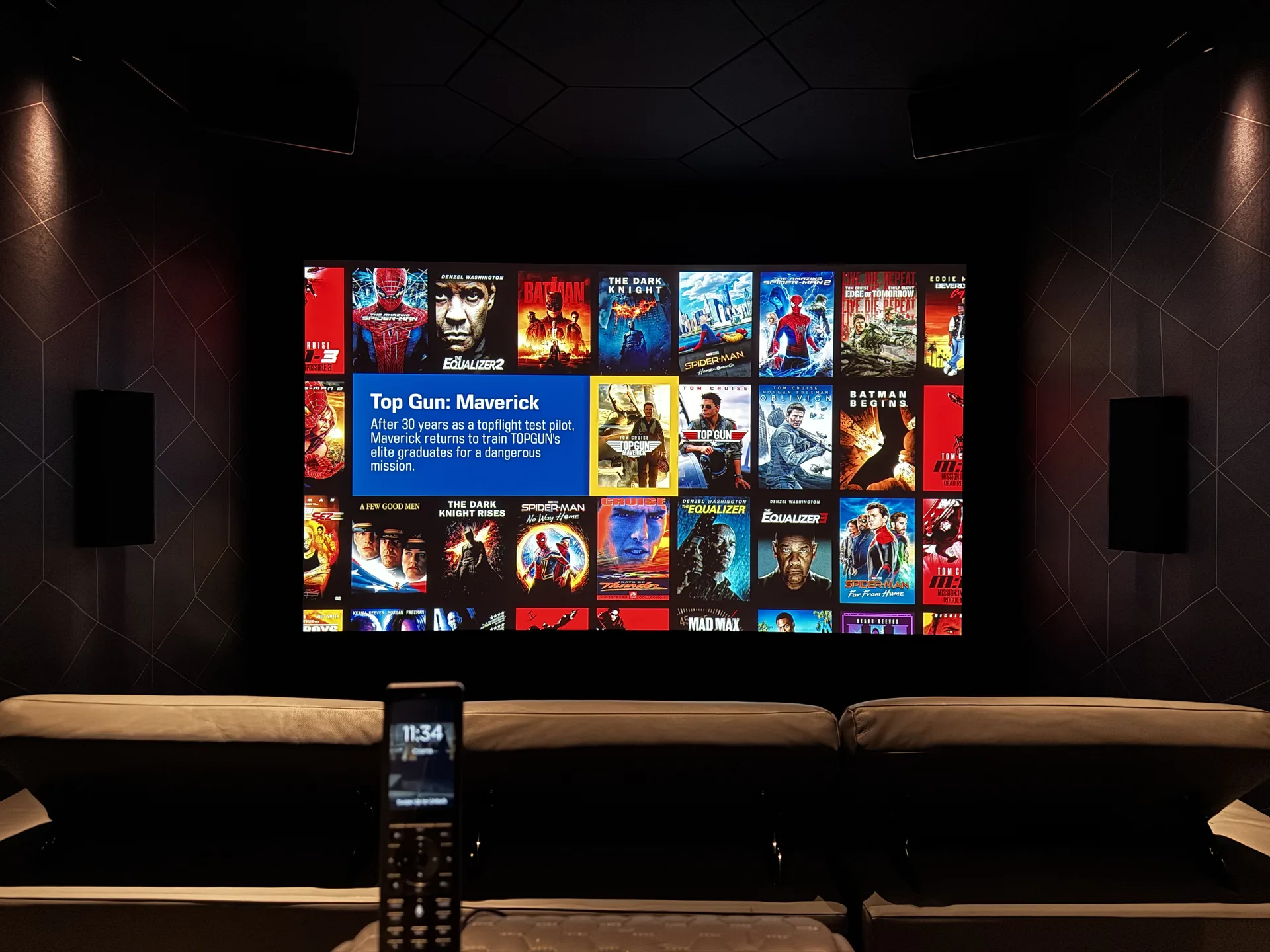
Treatment also doesn't have to look clinical. Fabric-wrapped wall systems can conceal panels, bass traps and even speakers behind a single seamless finish in almost any colour, with integrated lighting picking out the room's shape. The cinema in the photograph above looks like a beautifully finished room — the acoustic engineering is hidden behind the design.
What does it cost, and is it worth it?
For a dedicated room, a properly designed treatment package typically starts from a few thousand pounds for well-placed panels and bass trapping, rising for full fabric-wall systems with integrated diffusion and concealed speakers. It's rarely the biggest line in a cinema budget, but it is the one that makes everything else worth paying for. We would always rather a client spent a little less on electronics and invested in the room — the difference is audible from the first scene.
Hearing is believing, so the most useful thing we can do is play you the same scene in a treated room. Come and see us at our Maidenhead showroom, where you can hear a properly set-up cinema system for yourself — bring a film you know well and listen for what you've been missing.
Planning a Home Cinema — or Fixing One?
Whether you're building a new dedicated room or improving an existing one, get in touch or book a demonstration at our Maidenhead showroom. We'll give you an honest view of what your room needs — no hard sell.