Why energy has become part of the smart home conversation
Three things have converged over the last few years to make this a genuinely useful part of a project rather than a novelty. Solar panels have become cheaper and more efficient. Battery storage has come down in price and up in capacity. And EV ownership among our client base has gone from occasional to close to universal on new-build and major renovation projects. Individually, each of these is worth having. Together, and properly coordinated, they can materially reduce a household's electricity costs and reduce reliance on the grid at peak times.
The problem is that solar, batteries, and EV chargers are very often installed by three different trades, on three different control apps, with no communication between them. You end up with a solar inverter quietly exporting electricity to the grid for a few pence per unit at 2pm, while your EV charger draws expensive electricity from the grid at 6pm because nobody told it to wait. A coordinated system fixes exactly that.
Solar generation: the starting point
Solar PV generation is the foundation most energy management systems are built on. On a typical UK property, panel output varies enormously through the day and across the seasons — a well-oriented roof can generate several kilowatts at midday in summer and next to nothing on a December afternoon. The value of that generation depends entirely on what you do with it. Used to power the house directly, it offsets grid electricity at retail price. Exported to the grid under a feed-in tariff, it's worth considerably less. Stored in a battery for use that evening, it can offset a much larger chunk of your daily consumption than direct use alone.
This is where integration starts to matter. A smart home platform that can see live solar generation data alongside your household's actual usage patterns can make far better decisions than a standalone inverter working in isolation.
Battery storage: the piece that makes the rest work
A home battery is what turns solar from "useful when the sun's out" into "useful whenever you need it." Modern residential batteries typically store somewhere between 5kWh and 20kWh, enough to cover a meaningful portion of an average household's evening and overnight usage. The battery can be charged from excess solar generation during the day, from cheap overnight grid electricity on time-of-use tariffs, or a combination of both — and it can then discharge to power the house during expensive peak-rate periods.
The intelligence is in the scheduling. A well-configured system checks your tariff structure, the weather forecast for solar generation, and your typical usage pattern, then decides automatically when to charge the battery from the grid, when to hold charge for the evening peak, and when it's worth exporting surplus back to the grid instead. None of this requires you to think about it day to day — it should simply happen in the background, the same way your heating quietly maintains a set temperature without you adjusting a thermostat manually.
EV charging: the largest single load in the house
For most households with an electric vehicle, EV charging is by a significant margin the largest electrical load in the property — often larger than everything else in the house combined. That makes it the single biggest opportunity for smart scheduling. A 7kW home charger left to run whenever the car is plugged in will happily draw from the grid at full daytime rate. The same charger, integrated into a coordinated energy system, can be told to prioritise surplus solar generation first, draw from the battery second, and only pull from the grid during the cheapest overnight tariff window as a last resort — all while still guaranteeing the car is fully charged by the time you need it in the morning.
We install and integrate EV charging as part of wider smart home projects, coordinating the charger with the property's existing control system rather than leaving it as an isolated device with its own separate app.
On load management: for larger properties adding an EV charger, battery and other high-draw equipment to an existing supply, a proper load management assessment matters — both to avoid nuisance trips and, in some cases, to avoid an expensive supply upgrade. This is something we check at survey stage on every energy project.
Bringing it together: the control layer
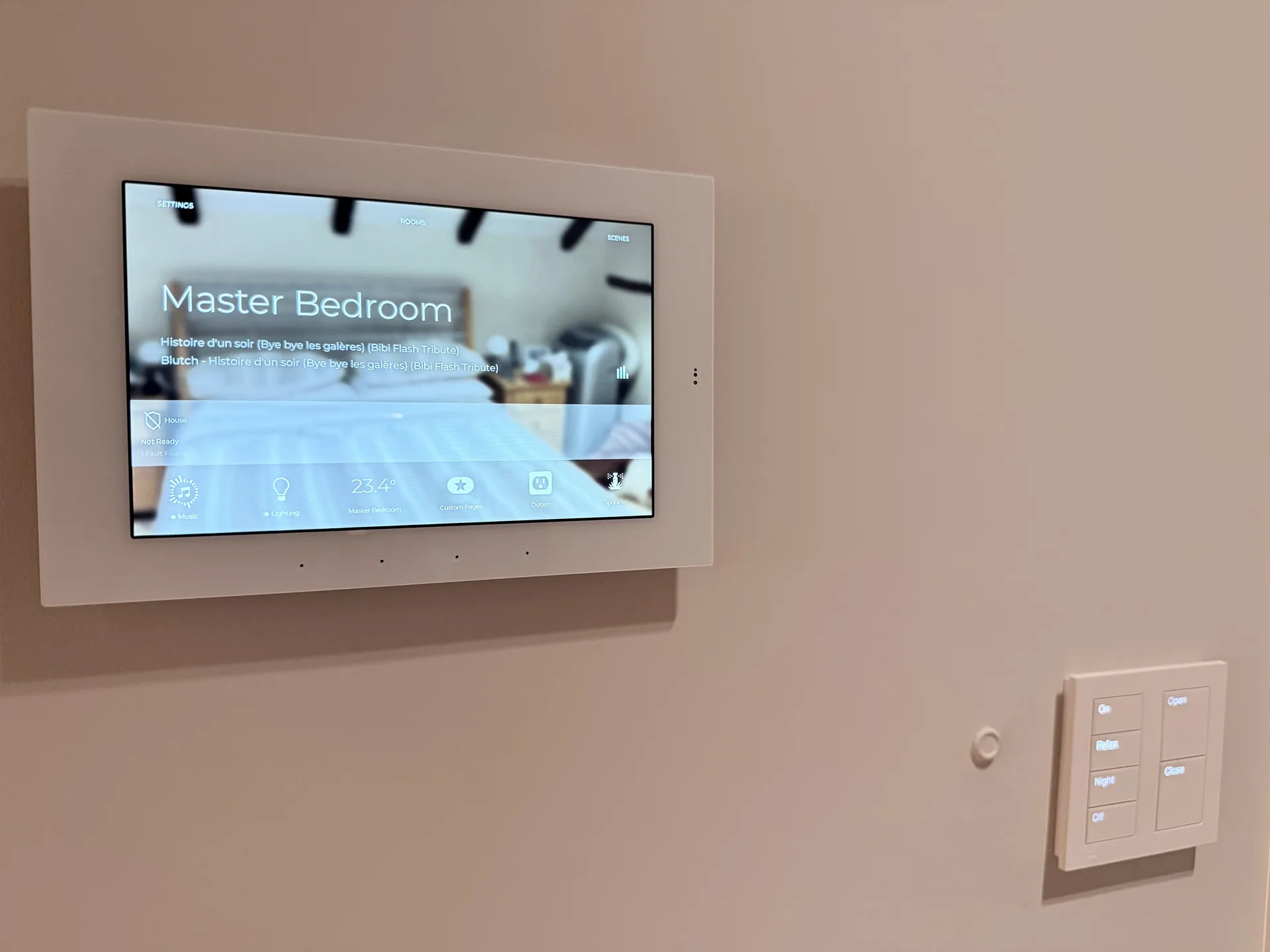
The platforms that do this well are the same ones we already use for whole-home automation — KNX, Savant and Crestron all now support energy monitoring and management as a genuine part of their ecosystem, rather than a bolt-on. That matters because it means solar, battery and EV charging status sit on the same touchscreen and the same app as your lighting, heating and AV — one place to see what the house is doing, not four separate apps for four separate systems.
For clients who want visibility without wanting to think about the detail, we typically configure a simple dashboard showing current generation, battery state of charge, and EV charging status, alongside automated rules running quietly in the background. For clients who want more control, the same platforms allow manual override — force a battery charge ahead of a forecast cold snap, or prioritise EV charging ahead of a long journey the next morning.
What a proper installation involves
Every project starts with understanding the property's existing electrical supply, current and planned solar capacity, battery requirements, and EV charging needs — usually alongside a wider smart home or renovation project rather than as a standalone job. From there we design the system architecture, specify the right battery capacity and inverter for the property, and integrate everything into a single control platform. Costs vary considerably depending on scope — a battery and EV charger added to an existing solar installation is a very different job to a full ground-up specification for a new build — so we always survey first and provide a fixed-price proposal before anything is committed.
See it working
The best way to understand how this all fits together is to see it running, rather than read about it. Our showroom in Maidenhead has a live demonstration of energy monitoring and control alongside our wider smart home displays, so you can see exactly how generation, storage and EV charging appear on the same interface as lighting and climate control.
Thinking About Solar, a Battery or EV Charging?
Whether you're planning from scratch or adding to an existing system, come and see it working at our Maidenhead showroom, or get in touch and we'll talk through what's right for your property.